
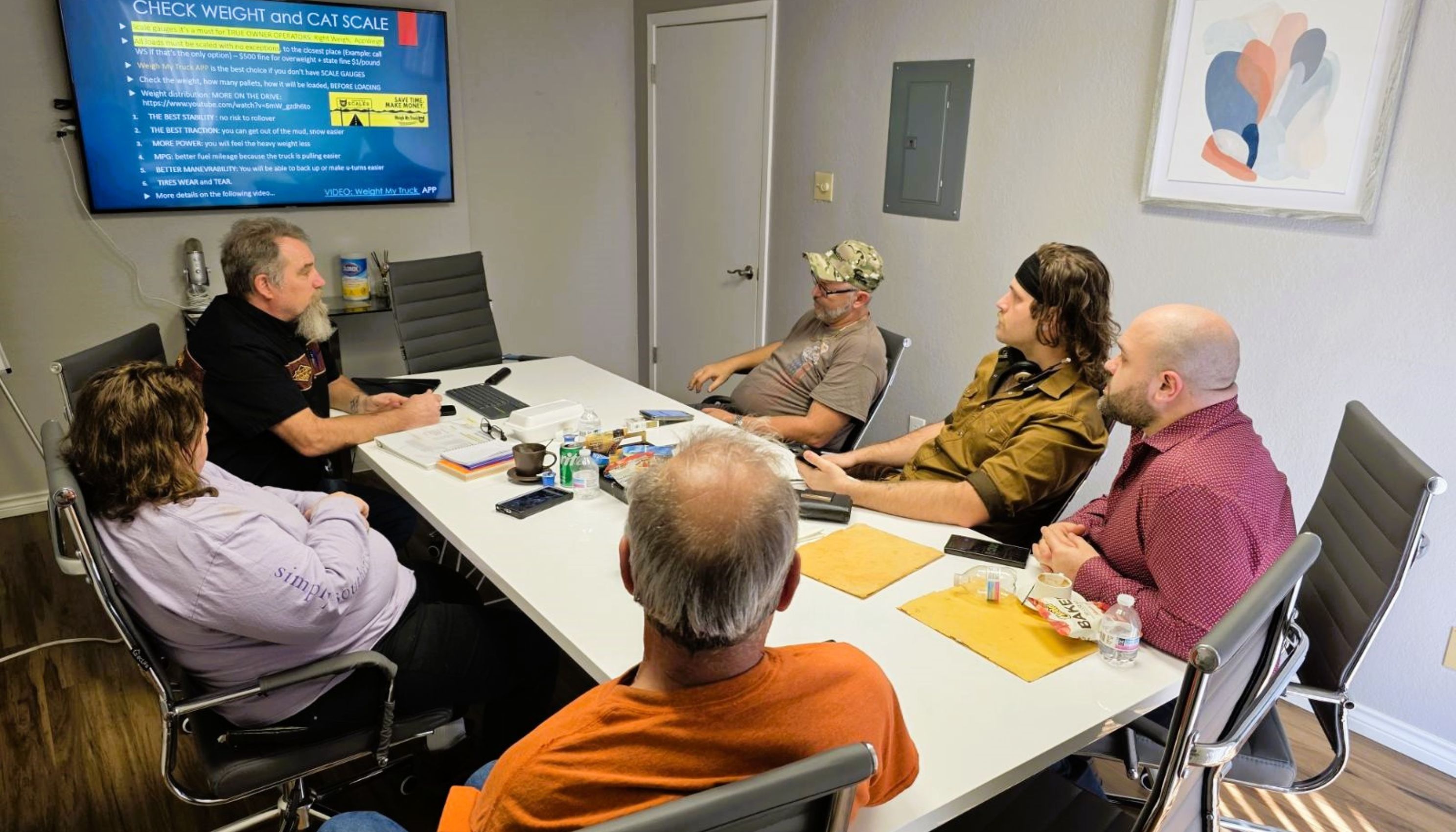
One of the very first and most important contacts a driver has with a carrier is orientation and training. For many people, outside the trucking industry, orientation may sound like a simple office day. In reality, it is where the company begins to show the driver how it operates, what standards it follows, and what is expected on the road. It is also one of the first places where safety, compliance, and performance all come together.
IT STARTS BEFORE THE DRIVER ARRIVES
The process usually starts with the recruiter. That first conversation matters. It is where new drivers begin to understand who we are, how we work, what kind of freight we move, what standards we have, and what they can expect before deciding to join the company.
Good orientation does not start in the office. It starts with the first honest conversation. Then comes the application process. Today, a lot of that can be done electronically, and that helps both the company and the driver. Digital onboarding makes the process faster, cleaner, and easier to track, but the work behind it is still serious.
Before a driver is cleared to start, at DOXA, we verify:
- the application
- CDL status
- driving record
- medical qualification status
- prior safety performance history from the previous three years of DOT-regulated employment
- pre-employment drug testing
- the required Drug and Alcohol Clearinghouse query before the driver performs safety-sensitive work
If everything is by our standards and we receive the drug test being negative, then we go ahead and sign the work agreement. We work just with 1099 contractors. Once the driver is approved and the agreement is signed, the real face-to-face part begins at our office on orientation day.
Good orientation does not start in the office. It starts with the first honest conversation. Then comes the application process. Today, a lot of that can be done electronically, and that helps both the company and the driver. Digital onboarding makes the process faster, cleaner, and easier to track, but the work behind it is still serious.
Before a driver is cleared to start, at DOXA, we verify:
- the application
- CDL status
- driving record
- medical qualification status
- prior safety performance history from the previous three years of DOT-regulated employment
- pre-employment drug testing
- the required Drug and Alcohol Clearinghouse query before the driver performs safety-sensitive work
If everything is by our standards and we receive the drug test being negative, then we go ahead and sign the work agreement. We work just with 1099 contractors. Once the driver is approved and the agreement is signed, the real face-to-face part begins at our office on orientation day.
WHAT WE DO
Usually, orientation takes about 8 hours in the office. This is the first real in-person contact, and it matters because this is where we explain who we are, where we come from, and where we are going. But more importantly, this is where we try to help drivers stay safe, avoid mistakes, protect their license, and make money the right way. A real orientation should cover the things that affect drivers every single day:
- hours-of-service
- how to use the ELD correctly
- inspections
- hours-of-service
- how to use the ELD correctly
- inspections
- maintenance
- weigh stations
- accident prevention
- paperwork
- billing
- pay
- bill of lading handling
- permits
- permit binder
We talk about the pre-trip expectations and the importance of being satisfied that both the tractor and trailer are in safe operating condition before moving. We also discuss cargo securement to prevent cargo from shifting, spilling, or falling from the vehicle.
Then we go to the yard and inspect bumper to bumper: truck and trailer. This inspection is done by a professional mechanic that needs to find all the issues before we break down or we get pulled over by dot officers. This is followed by a drive test to see the driver's skills.
Showing what to do, and what not to do, is often more effective than reading rules off a page. At DOXA, we use a lot of pictures and videos. We do it very attractively, asking questions and involving drivers. We make the orientation day practical and real. Because it must connect to what a driver will face on the road tomorrow morning.
- weigh stations
- accident prevention
- paperwork
- billing
- pay
- bill of lading handling
- permits
- permit binder
We talk about the pre-trip expectations and the importance of being satisfied that both the tractor and trailer are in safe operating condition before moving. We also discuss cargo securement to prevent cargo from shifting, spilling, or falling from the vehicle.
Then we go to the yard and inspect bumper to bumper: truck and trailer. This inspection is done by a professional mechanic that needs to find all the issues before we break down or we get pulled over by dot officers. This is followed by a drive test to see the driver's skills.
Showing what to do, and what not to do, is often more effective than reading rules off a page. At DOXA, we use a lot of pictures and videos. We do it very attractively, asking questions and involving drivers. We make the orientation day practical and real. Because it must connect to what a driver will face on the road tomorrow morning.
ASK QUESTIONS
One of the most important parts of orientation is simple: questions. When drivers ask questions, that usually means they care, want to understand, and want to improve. That is a good sign. Orientation should not be one-way talking. It should involve the driver. It should test whether the information is landing. Even the best orientation is not enough by itself. That is why, besides the in-office training, we also use online safety courses and questions at the end.
WHERE TRUCKING GETS HARD
There is a huge amount of work before a driver ever takes the first load for a company. And even with all that work, things can still go wrong. Drivers can still make bad decisions. They can still ignore training. They can still create risk.
The problem is that in the end still the company is the one suffering the most in case of a tragedy. The driver has limited responsibilities. The carrier is the one going to court and paying for everything. How is it possible? If the carrier followed all the legal rules, why are we still at fault? We need better rules so at the end to make clear where to where the company’s fault and then driver's fault.
The problem is that in the end still the company is the one suffering the most in case of a tragedy. The driver has limited responsibilities. The carrier is the one going to court and paying for everything. How is it possible? If the carrier followed all the legal rules, why are we still at fault? We need better rules so at the end to make clear where to where the company’s fault and then driver's fault.
SAFETY CARES MORE THAN PEOPLE SEE
In every trucking company, the safety team is one of the biggest reasons the company stays standing. A lot of their work happens behind the scenes. They review files, monitor issues, answer calls, solve problems, deal with incidents, follow up on compliance, and carry pressure that most people never see. They are often working around the clock, especially when something goes wrong.
When a truck is moving safely, most people do not notice the work behind it. But that work is there. And that is really the point of orientation. Good orientation is not a waste of time. It is not a box to check. It is one of the first real investments a carrier makes in safety, performance, and professionalism.
Disclaimer: This article reflects our personal opinions and experiences as a trucking company. It is not legal, financial or insurance advice, and it is not meant to accuse any specific person, company or profession of wrongdoing.
Disclaimer: This article reflects our personal opinions and experiences as a trucking company. It is not legal, financial or insurance advice, and it is not meant to accuse any specific person, company or profession of wrongdoing.